
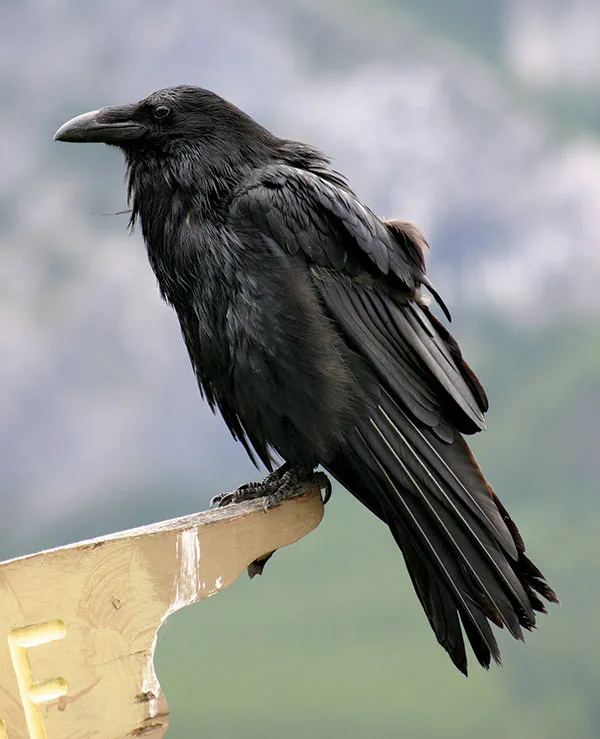
Today I will be talking about two interesting logical paradoxes. Both are completely irrational, yet derivable, and continue to pose problems to the philosophy of science. Let’s dive right into them.
Raven’s Paradox:
Suppose you want to prove the hypothesis “all ravens are black.” However, logically, this belief is equivalent to the statement: “all non-ravens are non-black.” In other words, if p is raven and q is black, then “if p then q” is the same thing as saying “if not p, then not q.” But here’s the problem. If seeing a black raven gives you evidence towards your conclusion, then seeing anything that is a non-raven and non-black should as well. So, if one sees a green apple, a red truck, or a blue popsicle, they should all be evidence towards the hypothesis. This seems illogical for many reasons. When we test a hypothesis, we usually attempt to find evidence supporting the hypothesis. But why can’t we just attempt to prove the contrapositive?
Philosophers have proposed a few reasons. One way out of this dilemma is to say that seeing a green apple is proof towards the conclusion “all ravens are black,” yet it is just not as strong of a measurement, i.e., it holds less value than what seeing a black raven would do. In other words, the degree of confirmation is smaller. However, in order to accept this, I think I would need to see this degree of confirmation quantified. Technically, a hypothesis is not provable—it can only be supported by finding enough evidence to create a conclusion beyond reasonable doubt. New information could always pop up, challenging a belief or contradicting a premise. If hypotheses are truly unprovable, then any amount of information leading to a conclusion—whether one sees a raven as black, or an apple as green—should be infinitesimally small in the grand scheme of things. If an infinite amount of knowledge is needed to prove a conclusion, and seeing a green apple provides 0.01 degrees of confirmation while seeing a black raven provides 100, both are similarly useless in the work towards a conclusion.
Other philosophers have used the Raven Paradox to challenge typical methods of confirmation. The Raven Paradox focuses on collecting data to prove a hypothesis. Philosophers like Karl Popper say that the reductio ad absurdum this paradox demonstrates means we should shift from confirmation to falsifiability. Instead of attempting to find ravens that are black, we should instead spend our time zeroing in on ravens that are not black. By doing this, we prevent the regression to infinity that begets pointless data collection while still providing a framework to prove assumptions.
Curry’s Paradox:
Let’s turn to another lesser-known, but even more dangerous paradox. Suppose your friend wants you to buy them ice cream. You agree to give them one sentence to convince you. They say, “If what I am saying right now is true, then I get ice cream.” At first, you think this is silly, but watch what occurs.
Case 1: you agree that your friend is telling the truth. If the sentence is true, the logic forces the conclusion that your friend gets ice cream. The “if” part is satisfied (“I am telling the truth”), so the “then” part must also hold (“I get ice cream”).
Case 2: here’s where it gets tricky. More realistically, you would say, “you are not telling the truth.” However, in order to prove that a sentence in the form “If A then B” is false, one must show that when A is true, B is not the case. In other words, one must find the scenario where A does not necessitate B. But then, in the very act of trying to disprove the sentence, you are proving that A (the clause “I am telling the truth”) is in fact true, but then trying to deny it ice cream. So if it is in fact telling the truth, then the sentence was true after all—bringing us right back to giving the friend ice cream.
The trap is that this sentence never says “I am false” like other paradoxes such as the Liar Paradox. Instead, it only says “If I am true, then something follows.” That means whether you call it true or false, the logic folds back into the same irrational conclusion. Worse still, the “something” could be anything at all: 2+2=5, unicorns exist, or every statement in the world is true. If Curry’s Paradox is admitted into our logical system without restriction, it trivializes everything, making truth meaningless.
Philosophers and logicians have tried to block this collapse in several ways. Some weaken certain rules of logic (like contraction) so the trick no longer works. Others build special kinds of logic, such as paraconsistent systems, where contradictions or strange self-references don’t spread into disaster.
Both of these paradoxes remind us of an important fact: even the most basic assumptions can be challenged.