
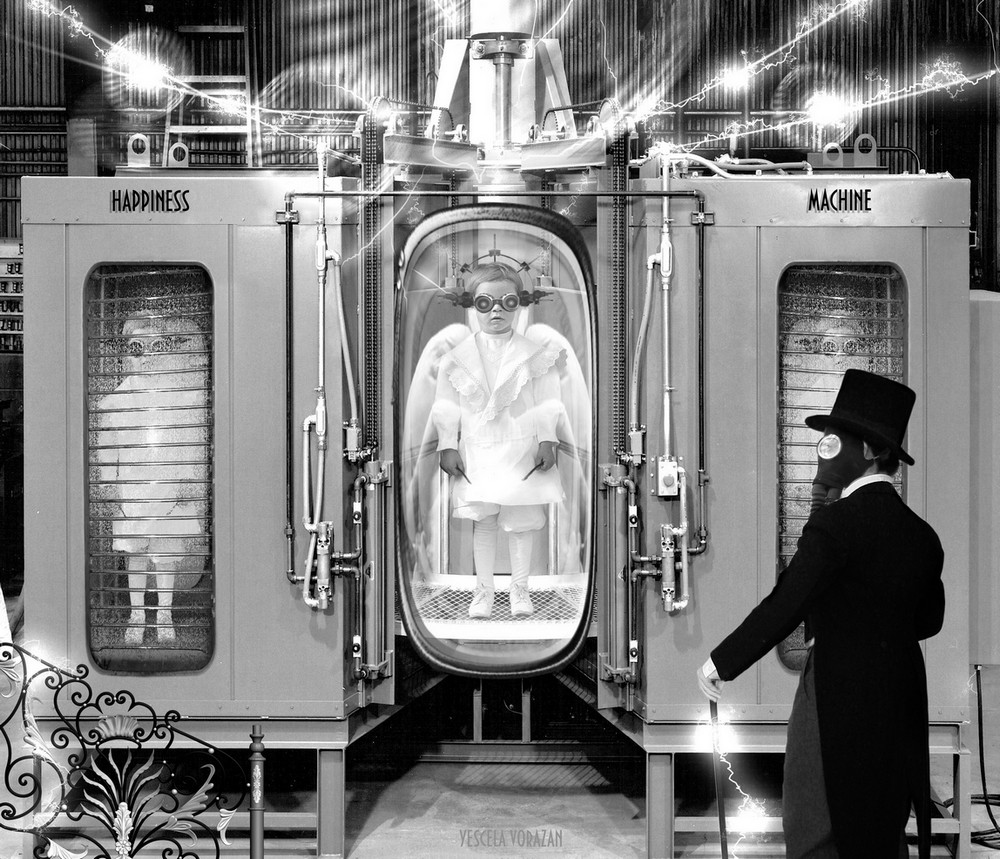
The Experience Machine, a thought experiment developed in 1974 by philosopher Richard Nozick, asks us a very simple question. If there was a machine that could simulate a reality that is perfect in every way, would you jump in? For the sake of the question, assume that this perfect reality molds to each person and gives you the ultimate pleasurable life each individual desires. The point of the experiment isn’t to find loopholes in the “perfection” of the reality, but to see if you would jump in or not. Additionally, assume that everyone, not just you, has access to the pleasure machine. Or, if the thought of leaving your family/taking yourself out of their lives scares you too much, assume that it is just you, in an empty universe. Either scenario will lead to the same conclusion.
According to philpapers.org, 77 percent of people chose to not plug into the machine. Keep in mind this survey was conducted on a philosophy website, but the result remains the same. Just as Nozick predicted, the majority of people will choose to not plug in. Before revealing my stance on this argument, I will reveal why Nozick thinks the majority of people choose to not plug in.
Nozick devised the thought experiment with the purpose of getting people to realize two things:
- There is more to life than pleasure.
- There is a difference between “feeling” and “being”.
It would seem as if the fact that the majority of people do not enter the experience machine provides strong proof for the first argument. If people truly thought that the only thing in life that mattered was happiness, they would have no qualms about jumping in. A clear line can be drawn here, many would say. The ones who decide to jump in are hedonists, while those who choose to stay are virtue ethicists or followers of desire-satisfaction theory. That is to say, they see more in life than the pursuit of pleasure.
Hedonism gets an unfair connotation, as the instant someone mentions hedonist all one thinks of is a drunkard in a festival. For clarification, I do not believe in moral/ethical hedonism, or that actions are good because they lead to pleasure and bad if they cause pain. That is a slippery slope of justification which can lead to some pretty awful conclusions. In fact, I would say morality and our motivations have very little in common.
I think we are all hedonists, if we are willing to use a broader definition, that is, we all strive to do the things that give us pleasure. Hedonism says nothing about how that pleasure has to occur. If helping others is what gives one the greatest sense of pleasure, and for example, getting drunk and losing all your money makes you unhappy, you are still chasing pleasure. This isn’t meant to discount altruism. In fact, helping others and receiving the subsequent ‘helper’s high’ is probably one of the healthiest ways to derive pleasure. Regardless, it does not get rid of the fact that the primary impetus for charitable behavior is the release of the coveted dopamine and serotonin chemicals. This might sound cynical, or merely be a reflection of my worldview, but I don’t care. Honestly, writing this blog is a way I gain pleasure so I’ll keep doing it. Working a job one hates could even fall under the hedonist logic, as if one didn’t work said job, and their family did not have enough to eat, they would feel extreme displeasure. Striving for happiness and resisting unhappiness are just two sides of the same coin, and sadly, most people do more of the second.
This brings us full circle to the first point I laid out. I think all of us are hedonists, and the people that refuse to jump in stay out for the sole purpose of maintaining their guise of moral superiority over the “immaturity” of hedonist thought. If not that, I would posit that those who choose to not jump in for this reason are clinging onto a false reality where they think they make decisions for some reason other than the pure pursuit of pleasure or avoidance of displeasure.
I can’t completely agree with Nozick’s second realization: that there is a difference between feeling and being. Many argue that another major reason people resist entering the machine is that they value the reality of their experiences—that is, they believe the real world is more meaningful than a simulation, even if, once inside the simulation, they’d have no way of knowing it wasn’t real. I think this claim is a far more valid reason for not jumping in, and to be honest, I can’t figure out my exact stance on it. I’ll provide both sides of the argument.
Those who would jump in would argue that on an individual basis, feeling and being are the exact same thing. In a simulated world, everything that you feel is in being—that is the terms of the question, and that is then your reality. You would never know that your feelings are not reality, and moreover, you would have no impetus to question in the first place. You’d be living in a permanent state of ignorant bliss, so deeply personal that your bliss becomes your reality. Who wouldn’t choose to jump in? Others would argue that we should have no inherent loyalty to this current reality. After all, followers of simulation theory, which I outlined in another post, would argue that we could be living in a simulation already. Why not jump to a better one?
Those who would not jump in use a thought experiment to make sense of another thought experiment. Imagine, for example, you have a girlfriend, boyfriend, spouse, partner—whatever. I’ll use girlfriend. You are concerned about the loyalty of your girlfriend, and you are offered two options: go into the machine, and have your girlfriend be loyal to you in the machine, but you are unsure about her fidelity in real life. The other option is to have your girlfriend be loyal to you in real life. Those who would choose to enter the machine might argue that both options are functionally identical—after all, inside the simulation, you’d never question your girlfriend’s faithfulness. However, I’m pretty sure everyone reading this would rather have the second option, revealing a gut instinct that there is a difference between reality and simulation.
So that’s my stance. I think if you choose to not enter the machine for some perceived notion that pleasure is not the sole thing you crave, you are mistaken. But if you choose to not enter because you see reality and simulation as fundamentally separate, and cannot bring yourself to make that split-second decision to jump in, I see a valid concern. Would you jump in, or stay out?

Leave a Reply