
I present in this article three conflicting views about how the world is made. Each view is plausible; however, some are more so than others. While Leibniz and Spinoza were 17th-century rationalists, the anthropic principle is relatively newer. As you can probably imagine, the older theories rely more on God/theology, while the anthropic principle is certainly atheist.
Baruch Spinoza was a Portuguese-Jewish philosopher and a strict hard determinist. Spinoza is best known for his belief in Pantheism, meaning he saw God in everything. Spinoza famously said that “a substance which is absolutely infinite is indivisible,” meaning that God, who in Spinoza’s view was infinite, as the ultimate creator, was impossible to divide and therefore was represented in every aspect of the material world. In other words, the world is not just God, but “in God,” and therefore finite things in the world all have God as their cause. They cannot exist without the initial power of God, as everything in the world is either God or a modification (mode) of him.
Spinoza’s metaphysics led to a profound system of necessitarianism, meaning that truths, objects, and facts are all necessarily the way they are. Not only is the nature of God necessary, but everything, since the whole world is caused, inspired, or devolved from him, must necessarily be the way it is as well. This presents a very rigid view of the making of the universe: that everything is exactly how it should be, and therefore, no other possible worlds can exist. Just as three sides are necessary for making a triangle, God is necessary for the universe to exist. One cannot make a “kinda triangle” — it is either a triangle, or it is not. Therefore, there is no in-between, and no other versions of the world can possibly exist.
How Spinoza goes about this necessitarianism is subject to debate. If we go back to Spinoza’s fundamental monism, where everything is comprised of one substance — be it Nature or God — he surmises that the rest of reality logically flows from God’s reality, like how proofs flow from an initial axiom. As the first axiom is necessary for the rest of the proofs, God is necessary for the rest of reality. This belief holds with Spinoza’s fundamental monism, that everything is God. If God is truly the only real substance, and everything else is God, it is in fact necessary that God must exist.
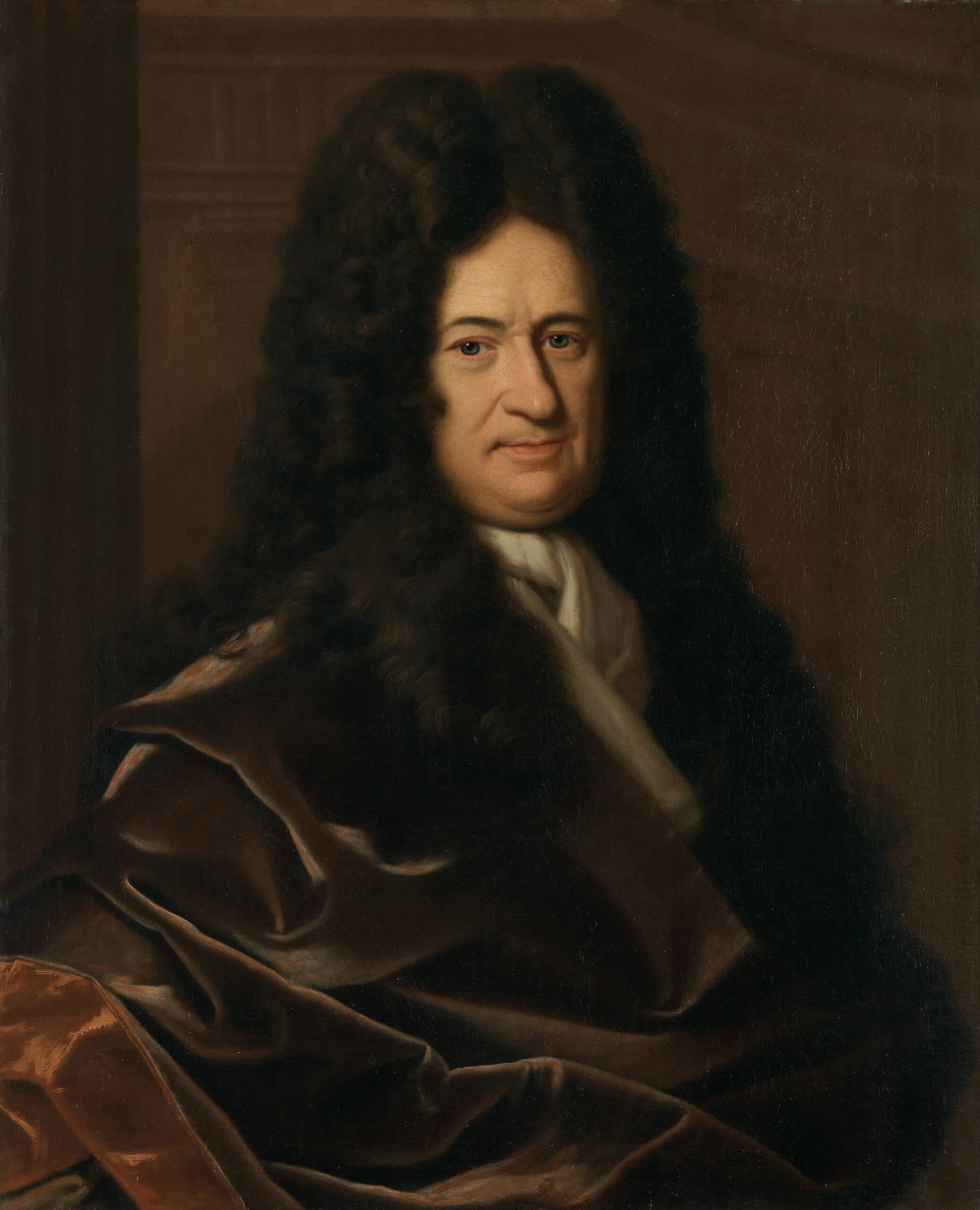
Gottfried Leibniz was another of the 17th-century Rationalists. Like Spinoza, his philosophy was firmly rooted in mathematics. However, his view of the development of the universe was nearly antithetical to the Portuguese thinker. Leibniz also firmly rooted his philosophy on — guess what — God. Leibniz’s works consist of his two books, Discourse on Metaphysics (1686) and Theodicy (1710). Leibniz posits that the world we live in is the optimal one God could have created. This is also known as the belief that we live in the “Best of All Possible Worlds.” This view was famously and savagely critiqued by Voltaire in Candide through the character Pangloss — an old man who insists he lives in the best of all possible worlds despite being tortured, beaten, and otherwise living a miserable life.
Leibniz rests his doctrine on the belief that God, being the ultimate creator, is benevolent, omnipotent, and omniscient. If God embodies these traits, the world they created must be the best of all worlds, as there must be a sufficient reason that God chose this world over the countless other possibilities. Leibniz posited that the reason this world was chosen over others is that it maximizes the ratio of good to evil — in other words, it is the nearest to perfection. This does not mean that the world is all-good; it just means that the world has the correct balance of good and evil to make it perfect. However, just saying this sounds contradictory. Of course, we can argue that evil things are necessary for good things to occur, but we should question why, with a God that is all-powerful and supposedly benevolent, evil things should happen in the first place. This is otherwise known as the problem of evil.
Through Pangloss, this is precisely the belief that Voltaire attacks in Candide. To him, it seems like a fool’s errand to believe in a God that allows the amount of suffering normalized to 17th- and 18th-century people to occur on a daily basis. If God were truly benevolent and all-powerful, it would be as easy as a snap of the fingers to change the world. Leibniz responds to this belief by stating that (a) any world may have some portion of evil, (b) some evils are necessary for greater goods, and (c) a world without evil may be less perfect overall. Still, these objections seem like strange, unintuitive logical loopholes. Unless we fully accept that God knows what is best for us, and our tiny human brains cannot fathom even a fraction of his infinite intellect, doubt is seriously cast on this stipulation.
The anthropic principle is a modern theory that does not rely on God. It has multiple formulations — some count over 30 — but only two of them are really prominent: the weak and strong principles. The weak anthropic principle posits that the fact that the universe contains life-giving principles is not surprising, because if it did not, we would not be here to observe it. Sounds obvious, right? Well, the implication is that our location in the universe (in time and space) is biased by the requirement that it must be compatible with our existence.
The strong anthropic principle takes the implications of the weak principle and ups it a notch. It states that the universe must have principles that allow the world to be observed, which some interpret as the thought that life is a necessary outcome of the universe’s laws. It is not just that we live in an observer-friendly universe; the universe was meant to be, or tuned, to have brought about observers. This can verge on the interpretation that the universe was created to sustain observers.
Of all the beliefs, this (Strong Anthropic Principle) and Spinoza’s necessitarianism align the most closely. Both posit that the universe is not one of infinitely many possibilities, but the only one that can exist. For Spinoza, the constants of nature had to be what they are — there is no metaphysical space where they could differ. Likewise, for followers of the strong anthropic principle, life constants are necessary attributes of the only possible reality. On the other hand, the weak anthropic principle and Leibniz’s doctrine of best possible worlds fit together. The views agree on the metaphysical stance that many different worlds could exist, but both posit that our world was picked for one reason. For Leibniz, this reason was that it is the best of all possible worlds. For followers of the weak principle, the reason is the fact that if we did not exist, we could not observe it — so of course we find ourselves in an observable universe. One could even interpret the weak principle in Leibnizian terms: in the best of all possible worlds, observers can be supported.