
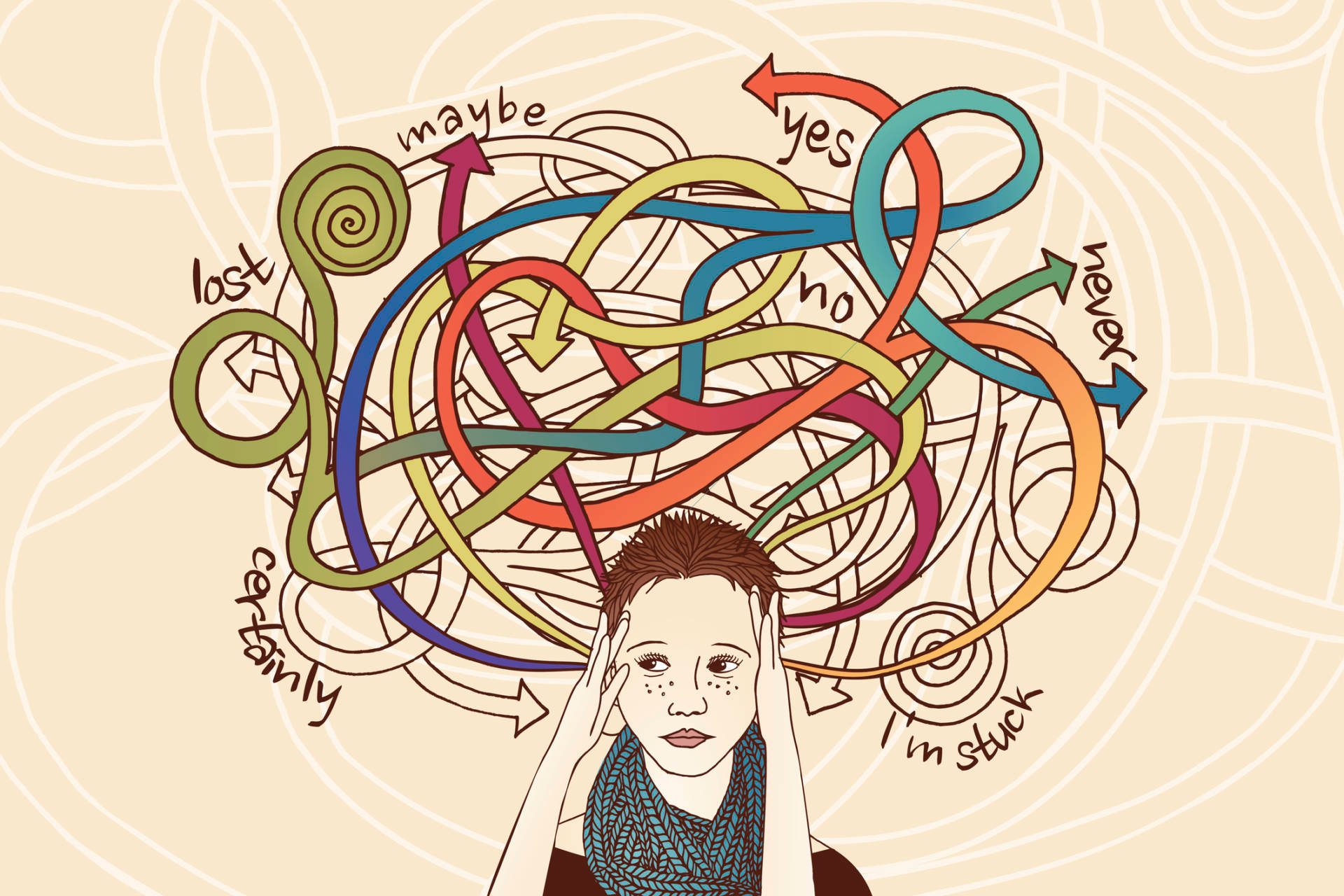
Have you ever been trapped in a spiral of negative thoughts, where you suddenly doubt things you were certain of moments before? I think the vast majority of us have had this experience, in times not related to philosophy. Biologically, self-doubt has evolved as a form of risk management, a mechanism that ensures we check our assumptions against reality before moving on. But self-doubt can also be dangerous: when we trap ourselves in cycles of uncertainty and indecision, it can lead to paralysis and altogether negative outcomes.
Epistemic self-doubt is simply the experience of questioning one’s own ability to hold true beliefs. A person experiencing epistemic self-doubt doubts their own credibility as a knower. Through this reasoning, a paradox emerges. If the conclusion is right, the process was wrong (meaning the conclusion is suspect). If the process was right, the conclusion (that you are a poor judge) must be wrong. Thus, if one can doubt their own validity as a knower, then, through the same logic, they should be able to doubt the very judgment they used to assert that claim upon themselves.
This is paradoxical and has wide-reaching ramifications. Is all doubt paradoxical? Should we always be sure of our actions and never reconsider our measures? Of course, we know that this isn’t true. There are times in all of our lives when we double-check something and realize that the first time we did it wrong. The problem, then, is in deciphering when we can and cannot firmly justify our doubt.
The way out of this paradox rests in the assumptions of epistemic humility. In more ways than just this, philosophers have proven that we cannot know the world around us as it is exactly in reality; what we perceive is a convoluted fragment of it, twisted and reshaped by our own minds. Epistemic humility serves as a baseline for us to admit that while our “knowing equipment” is imperfect, it is the only equipment we have. If we disregarded it, we would be floundering around in the dark, with no clear direction nor end in sight. We don’t need to be certain—just reliable enough to function.
Thus, our justification for doubt must rely on externalism. We can’t check the equipment of our brain, so we need to verify the conclusions we reach against one another. This invites the doctrine of pragmatism. While traditional philosophers see truth as a supposed mirror of reality, pragmatists see truth as an assessment of practicality. At first glance, pragmatism may seem wishy-washy. If we can fit “truth” to anything that we want—i.e., what benefits us practically—then it seems truth loses all of its meaning. But in the face of epistemological challenges such as the paradox of self-doubt, pragmatism suddenly makes more sense. If we can’t be sure of the truth, or even if we can be deservingly unsure of our unsureness of the truth, the “mirror” definition of truth seems to run into a brick wall.
Therefore, pragmatism seemingly fills an explanatory gap. Applying it to self-doubt, we see that pragmatism allows us to work inside the confines of what we can directly know—and not be constantly limited by an omnipresent fear of self-doubt.
Epistemic self-doubt is not an inherently bad mechanism. It keeps us safe, preventing blind confidence and checking assumptions. However, it can go overboard if unrestrained, possibly undermining the possibility of knowledge itself. If one truly and seriously doubts their truthfulness as a knower, then that doubt itself is doubted too. This can create a cycle of paralysis. If we adapt our cognitive assumptions into a state of epistemic humility, we can mitigate this paralysis by sacrificing the possibility of unquestionable truth. Combining this with pragmatism—truth as a practical conjecture instead of a reflection of reality—we see that not only is certainty unattainable, it is also not necessary.