
Category: Logic
-
I Think, Therefore I’m….Not? What did Descartes Actually Prove?
One of the first ideas in philosophy people often hear is Descartes’ famous Cogito, Ergo Sum: I think, therefore I am. In this post, I’d like to dissect the phrase, offer its true meaning, and challenge Descartes on its overall implications for knowledge. I’ve discussed earlier in this blog how Descartes arrived at this landmark Read more
-
Prepare for the Predictor: Why One-Boxing Wins Newcomb’s Problem
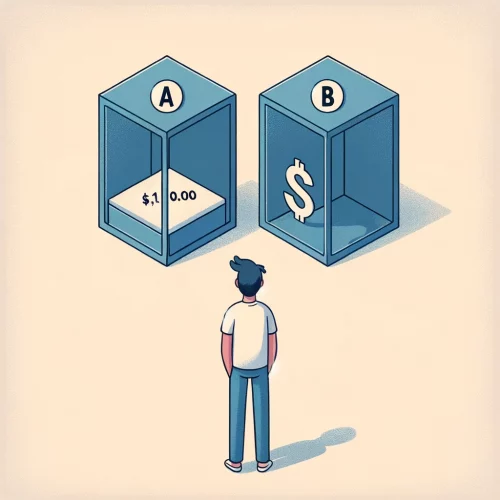
“If you fail to plan, you are planning to fail” -Benjamin Franklin The Problem Newcomb’s problem is one of the most famous problems in the branch of philosophy, probability, and mathematics called decision theory. What’s even more interesting, in my opinion, is that contemporary philosophers are nearly split down the middle between one-boxing and two-boxing. Read more
-
Newcomb’s Paradoxical Problem
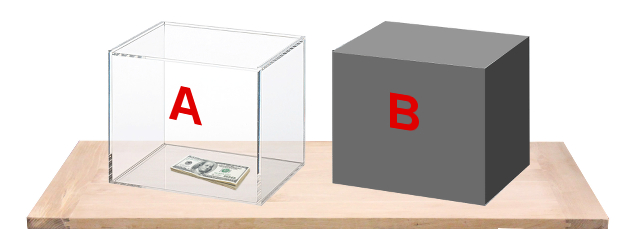
Newcomb’s problem is one of the most famous problems in the branch of philosophy, probability, and mathematics known as decision theory. What’s even more interesting, in my opinion, is that contemporary philosophers are nearly split down the middle on the answer. Here is the paradox, taken from the Stanford Encyclopedia of Philosophy: “An agent may Read more
-
A Illogical Skeptic Argument
I’d like to talk about the skeptic argument, which attempts to show that true knowledge is impossible. I think that (a) the conclusion really shouldn’t be as crazy as we think and (b) the argument doesn’t rule out all types of knowledge. First of all, let’s go through a standard version of the argument against Read more
-
Raven and Curry’s Paradoxes
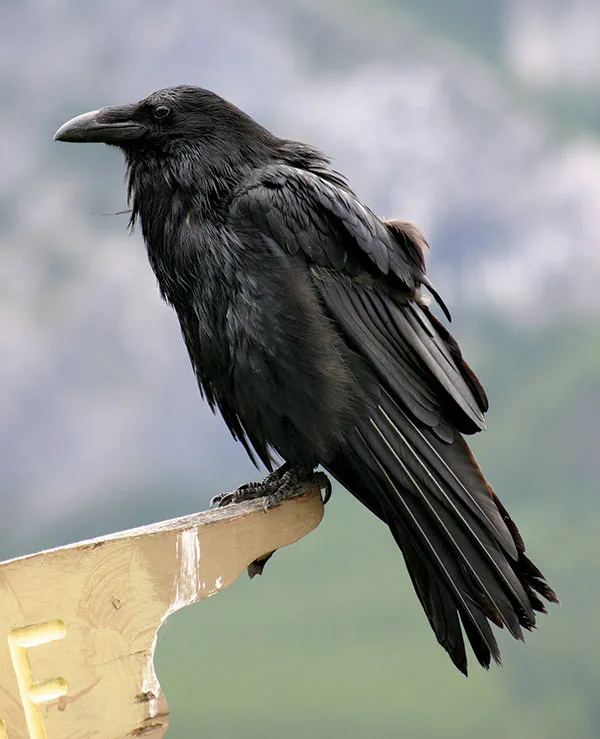
Today I will be talking about two interesting logical paradoxes. Both are completely irrational, yet derivable, and continue to pose problems to the philosophy of science. Let’s dive right into them. Raven’s Paradox: Suppose you want to prove the hypothesis “all ravens are black.” However, logically, this belief is equivalent to the statement: “all non-ravens Read more