
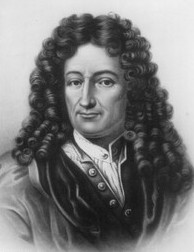
Like many debates in philosophy, the dispute over the nature/existence of God has no clear answer. In this particular argument, the ball lies in the court of the theist, giving them the chance to create a logical argument deriving God as a conclusion from justifiable premises. There are many ways theists have done this. Some, like the argument from design or the ontological argument, are quite weak. However, other arguments are quite strong, such as various formulations of the cosmological argument. In this paper, I’ll present the strongest current proof for God’s existence: Leibniz’s argument from Contingency.
My first encounter with Gottfried Leibniz was in Candide, where he was ridiculed as a bumbling fool. My second was in math class, where I thought his notation was confusing. But Leibniz was an extremely impressive thinker. He had tremendous expertise across fields, something that doesn’t really happen anymore. Leibniz’s argument for God relies on something I’ve already covered on this blog, the Principle of Sufficient Reason (PSR). Assume:
- PSR: Every contingent fact has an explanation for why it is the case rather than not.
- The PSR holds that nothing simply “exists” without an explanation. In other words, everything must have a reason why it is the way it is, rather than some other way it could be. Leibniz rejects the idea of “brute facts” — things that exist without any reason at all. When he speaks of a “contingent fact,” he means something that could have been otherwise and therefore requires an explanation for why it is as it is, instead of different or nonexistent.
- The fact that a contingent universe exists is itself a contingent fact.
- The existence of the universe is a binary that could have been the other way—i.e., the universe could not exist. Due to this, following the PSR, there must be a reason why the universe exists in the first place.
- Therefore, the universe must have an explanation outside itself.
- Explanation cannot come from the inside. For example, the reason that a carrot is orange cannot just be because it is that way—that would be a “brute fact,” which Leibniz denies the existence of. We know that the carrot is orange because it was selectively bred to have a higher concentration of beta-carotene, which is converted to Vitamin A in the body. Therefore, the reason that the carrot is orange is contingent on the reasoning of Dutch farmers in the 17th century, which is then contingent on other facts.
- That explanation must be a necessary being — something whose nonexistence is impossible.
- This is where it gets a little confusing. As a reminder, we are trying to explain why the universe exists instead of being nothing. We just determined that that reason cannot come from inside the “universe.” Thus, the reason that the universe is the way it is must be inherently metaphysical—because without the universe in its entirety, physical things do not exist. Thus, the reason that the universe is here must come from something before the universe, before anything ever existed. Therefore,
- The best candidate for such a necessary being is God.
- Pretty self-explanatory. The argument basically forces the conclusion that a being like this must exist.
Leibniz’s argument is quite strong. If everything has a reason, then the universe must have a reason to exist as well. Quantum physics doesn’t solve the problem: it studies chaotic matter already in existence, not the coming-into-existence of matter itself. The Big Bang can’t help either: it reveals how our current universe developed, but it still doesn’t solve the problem of how the matter involved in the Big Bang came into existence. For all we know, the Big Bang was just the catalyst for this universe—possibly one universe out of millions. Point is, we can’t prove it.
I think the easiest way to attack this argument is by denying the claim that brute facts cannot exist. Bertrand Russell famously did this—he quipped, “The universe is just there, and that’s all.” What he meant by this was that we don’t necessarily always need explanation: some things just exist, and we shouldn’t feel that we need a way to explain them, because it either may not exist or may be a purely psychological drive that is unnecessary. Philosophers like Hume have argued through history that explaining the local causes and effects is all that is necessary—kind of like a weak version of the PSR. For example, you can say that every point in a set has a mother, but that does not mean that the whole set has a mother. One can argue that you really don’t need to prove, in this example, that the “whole set has a mother,” and that it is sufficient to simply determine the mother of each point and all the points near it, possibly ad infinitum.
Additionally, an atheist can use Occam’s razor to their benefit here. If one can explain events in a chain with purely local explanations, then invoking a metaphysical being as the endpoint of the chain is completely unnecessary. It can be argued that the desire to do this is a purely emotional thing, and that it actually has no grounding in reality. Theists may just be in search of an answer, demanding an explanation when the simplest and most ontologically parsimonious answer is that no explanation exists at all.
Still, the veracity of this argument is excruciatingly difficult to deny. The idea that everything has a cause is so very intuitive it is difficult to argue against. I’m not entirely sure where I stand, but I guess one could say that our perceptions of causality are, in the grand scheme of things, minuscule, and that causation is less intuitive when we get to chains of causality that extend toward infinity.
Lastly, one can always make the argument that causality is not a priori, i.e., it is dependent on our senses and therefore is never 100 percent reliable. This is kind of like the “you think your grass is wet, so you assume it rained, but it is possible your neighbor could have just spit all over your lawn” argument. Often, we only see the before and after—not the actual mechanism that causes change. So to invoke causality as necessary for explaining the universe could be contradictory.
Ultimately, Leibniz’s argument is not about God directly, but about whether we can tolerate brute facts or whether reason demands a necessary ground for all existence.