
As I covered yesterday, scientists and philosophers alike struggle broadly to define a conception of the relationships between consciousness and the world. Materialism, or the theory that mental processes arise from purely physical elements, has been widely critiqued. Likewise, mind-body dualism, similar to what Descartes radically proposed in the 17th century, deals with its own problems. We can assume that the mind and body have some sort of relationships on each other, i.e., if someone has a paralyzed arm it will affect their mental state as well. However, in a strict dualist sense, if the mind and body are purely separate entities, how can a relationship plausibly develop between two fundamentally separate things (substances?).
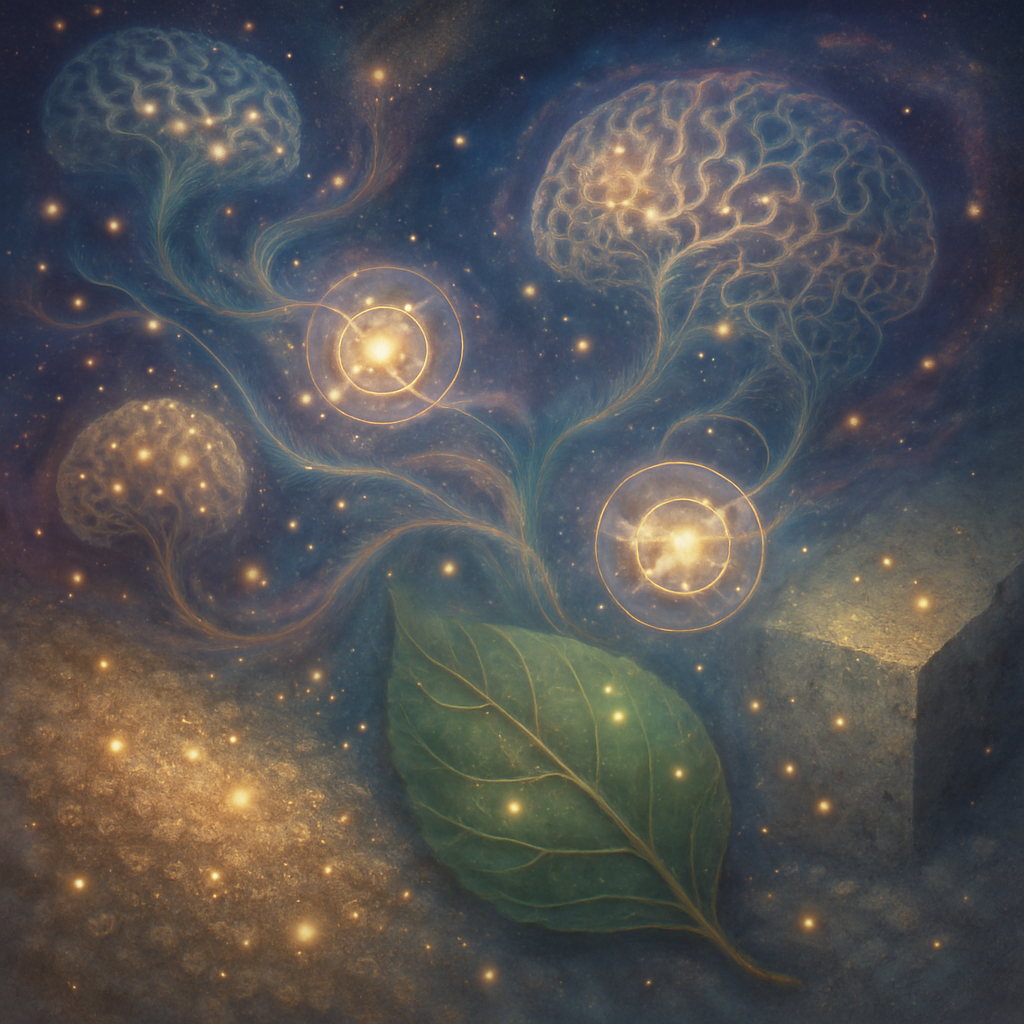
As the problems posed to dualism cannot be easily reconciled, we find ourselves in a tricky position if we wish to discover the true relationships between mind, body, and consciousness. A radical theory that looks to combat this is called panpsychism: the idea that everything, at its base state, is conscious. This theory stands in direct opposition to materialists, as while both theories hold that reality is fundamentally composed of a single kind of substance, the substance is different. Panpsychism is commonly thrown out in discussion as a theory that poses that sand, leaves, and concrete all have consciousness. While some of this criticism may be deserved, it is important to take a closer look before throwing it out.
So what really is panpsychism? The first thing to understand is what philosophers call the hard problem of matter. An easy way to illustrate the hard problem is our current language. We only know matter in its relations to other things; likewise, we don’t know what matter is in itself. If this sounds similar to something you have heard before, you would be correct. The hard problem of matter is very similar to the hard problem of consciousness. Physics gives us structure and dynamics of matter, but not the intrinsic nature of the thing that has that structure and does that behaving. In the same way that neuroscience can explain brain processes but fails to explain qualia, physics can define relationships and structure but not true “essence”.
Consider the smallest known molecule. We can describe its mass, charge distribution, energy states, and how it interacts with other particles. Quantum mechanics allows us to predict its behavior with unbelievable precision. But all of this information—no matter how detailed—tells us only how the molecule behaves, not what it is in itself. Our best understanding constantly changes as well. Ancient Greeks thought that the smallest particles were atomos—uncuttable, tiny atoms—that differ in shape or size. In the early modern age, it was thought that all matter was made of indivisible atoms of different elements. Now, we hypothesize that the smallest known particles are quarks and leptons. But what’s the proof that conception of the smallest particle will not continue to evolve? We can neither define what matter truly is, nor what it is in itself: physical science gives us the form, not the essence.
The radical leap posed by panpsychist philosophers is that the hard problems of consciousness and matter can solve each other. Matter is out of our reach, as we know of it scientifically but have no clue what it is intuitively (we lack a conception of its essence). On the other hand, we know consciousness (qualia) intuitively, but lack the slightest clue of what scientific mechanisms cause it. This fundamental problem in the understanding of both our mind and reality has led some philosophers to suppose that the problems solve each other—like canceling each other out. What if matter, at its base, is really mental? This is a huge leap, no doubt, and it speaks to the current state of the philosophy of consciousness that such a radical theory could gain so much traction.
But just as soon as the two hard problems are solved, it seems, a new one arises. If all matter is fundamentally mental, how do large-scale physical structures—which most of us should intuitively agree to exist—arise from micro-level consciousness? This echoes the same difficulty dualists face—explaining interaction across ontological divides—and is something we are forced to deal with.