
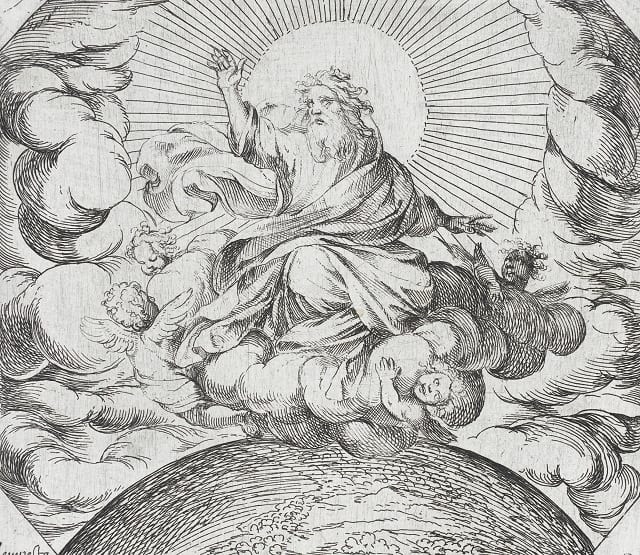
After proving the existence of his mind, Descartes figures that the next logical thing to prove is the existence of God. He does this in two ways. I will explain one of them here, and then provide arguments against it. I’ll explain the other, much more complicated one later, when I better understand it.
Descartes’ first proof is the ontological argument. This argument is quite simple. Descartes posits that God, the perfect, supreme being, is perfect in every single way. This means God has the maximum ability in every single attribute, like strength, wisdom, speed… etc. You get the point. Descartes then says that existence is an attribute. If God is the perfect being, which most people would agree with, he must “perfectly” exist in real life. If God only existed in the mind, he wouldn’t be as perfect as a being that existed in real life. So therefore, God must exist.
But this brings us to the classic question of: if God is perfect in every way, why does evil exist? Surely goodness, or virtue, is an attribute that God must be perfect in as well. Descartes answers this in somewhat of a roundabout way. Descartes believes that God gave humans free will. This in itself is reason enough to doubt the argument, as the concept of free will/determinism is such a heated debate, but we cannot necessarily disprove this premise. Let’s just run with it. God, in his perfect state, decided to give humanity free decision-making skills. With this freedom, humanity necessarily becomes imperfect. Since they are capable of making their own actions, without the supreme wisdom of God, they cannot attain the same level of perfection that God has. This, Descartes says, is the root of all evil. Human error is why evil occurs. Because humans are less perfect than God, and God has given them free will, they misinterpret what is good for them, and subsequently evil arises in the world.
I say this solution is roundabout because theoretically, none of these human actions/missteps would matter to an all-powerful God. If God was perfect in every way (perfectly good as well), it would still be completely within his capabilities to stop the mistakes of humans, like how a mom steps in when kids are bickering. This leaves Descartes with two options (this is a hypothetical; I am not sure he explicitly answered this question): he can either 1. Argue that God chooses not to interfere in the actions of humans, or 2. Say that God cannot interfere with the actions of humans. Obviously, Descartes would answer with 1. If Descartes said that God cannot interfere with humans, then he wouldn’t be supremely perfect.
This leaves us with the question of why then God would choose to not interfere with the actions of humans. Descartes’ classic answer is that God, being supremely wise and intelligent, knows what is better for us and has a master plan which does not need interference. This is a plausible answer. Another answer is that God gave us complete, ultimate freedom—freedom that is so strong that even he could not control us. But that answer brings up the classic paradox: Can God create a rock so heavy he can’t lift it? The jury is still out on that one. A third and final argument is that God only chooses to interfere with those who believe in him. This seems valid until you consider the fact that God, being supremely perfect, must also be perfectly impartial and perfectly compassionate, as both are positive virtues that, under Descartes’ premises, must be maxed-out.
There are a few other problems with the ontological argument. Most have to do with existence being a predicate of the argument. An easy way to see why existence is not exactly an attribute or property, like speed or strength, is the thought experiment of a perfect island. If an island was perfect in every way, and existence was a property, that island would have to exist. But we haven’t found a perfect island, so either it’s still out there, or it doesn’t, in fact, exist. There are all sorts of mind-games you can play, but all of them disprove the existence as a property.
Another problem is with the assumption that God is perfect in the first place. Descartes just assumes that God is perfect, and uses that logic working backwards to prove that God exists. This is very fishy, as one would naturally inquire what makes God perfect in the first place—especially in light of all the troubles raised in the middle of the post.
The cosmological proof, although more complicated, makes a better argument than this, which is widely critiqued.