
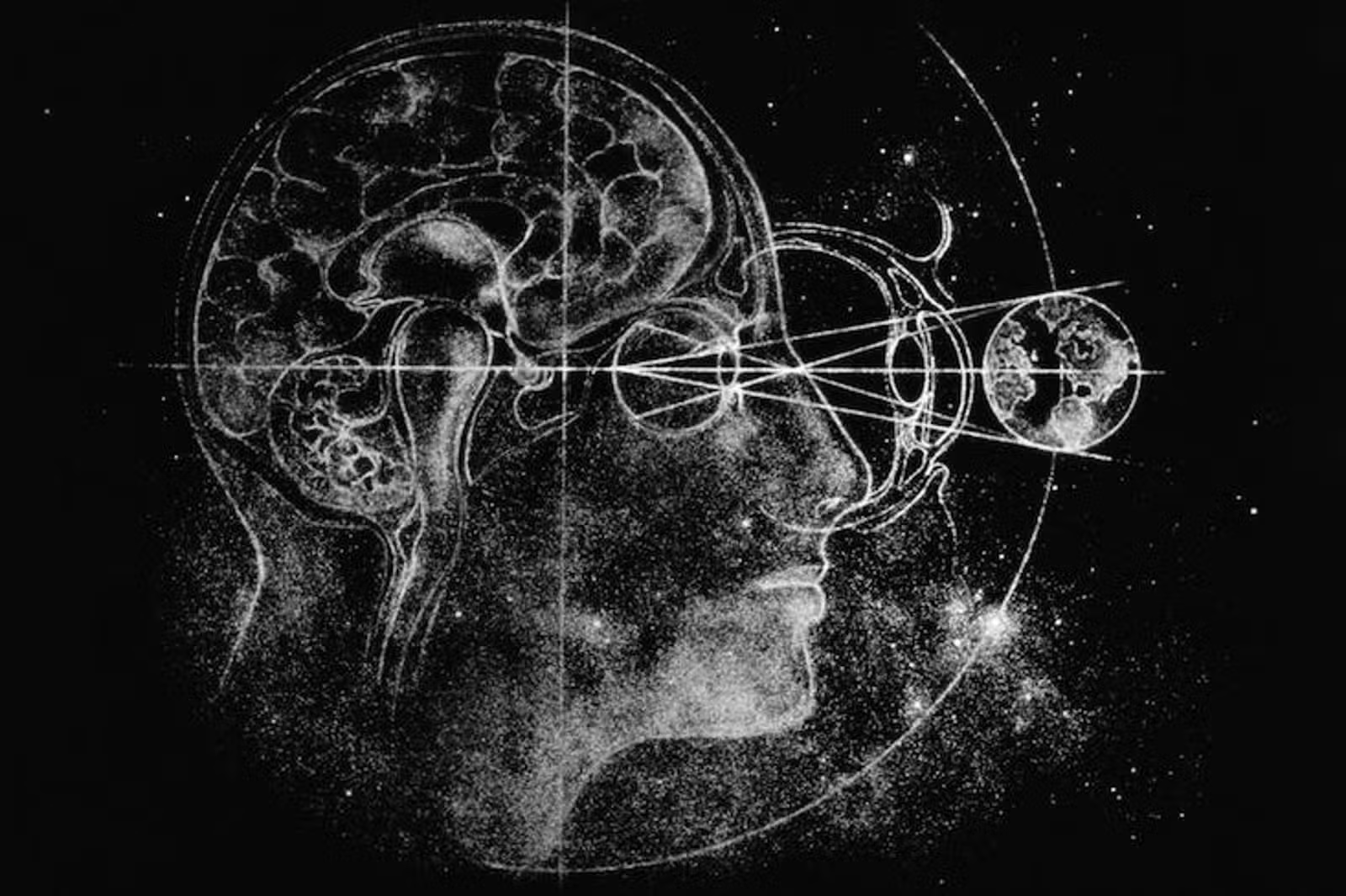
The ideas of Boltzmann Brains and Simulation Theory are interesting concepts that seem both logical and completely impractical at the same time. They’re funny brainteasers that, while impossible to disprove, can be thought about—and then discarded. Nonetheless, they’re worth sharing.
Boltzmann Brains were a thought experiment proposed by Austrian physicist Ludwig Boltzmann. Before diving in, it’s important to understand the concept that events with near-zero probability still have a high likelihood of occurring over an infinite timeframe. The easiest way to wrap your head around this is the idea that, given infinite time, monkeys could type the complete works of Shakespeare or recite all the digits of pi. No one can disprove this idea, as there’s no way to argue against—or even test—something that is infinite. If we accept these absurd scenarios as plausible, what if our own existence is nothing more than an “infinitely unlikely” event in an infinitely long universe?
This belief is central to the Boltzmann Brain hypothesis. Modern science suggests that our brains are ultimately just configurations of atoms—or even smaller constituents like quarks or strings, depending on the scale of analysis. If one adopts this physicalist view, then one must also accept that, over an infinite timeframe (such as that proposed in some cosmological models), even something as unlikely as a brain forming spontaneously out of random atomic arrangements could occur. One might object, saying this can’t be true because they have memories of the past—but under this view, those memories are just physical patterns, indistinguishable from ones that were formed randomly. In this scenario, we could be nothing more than a “brain” floating in space, with all of our perceptions and memories spontaneously generated. To some, this is a deeply unsettling possibility.
As far as I know, there is no mainstream support for the idea. Still, it persists—I stumbled across it over 100 years after it was proposed. The most common use, as my dad tells me, is as a reductio ad absurdum: a way physicists dismiss competing ideas by taking them to a logical extreme and then exposing contradictions.
Simulation Theory relies on some of the same principles, but instead of you being fake, it’s the entire world. Simulation Theory has gotten some mainstream attention through movies like The Matrix, but again, is mostly discarded by philosophers and scientists alike. The crux of the argument rests on the very very very tenuous claim that one day humanity will be able to replicate real existence in an uber-advanced technological society. If this were to happen, and a civilization could simulate reality, it would be naive to assume that it was the first to ever do so. In other words, if humans have just figured out how to create simulated realities, who’s to say we aren’t already living in one? Of course, you could just reject the premise and accept that humans will never be able to simulate reality, and if so, the argument is null.